Request A Quote
 Contact Us
 South Africa (Select Country)

 India
 Australia
 UK
 USA
 Malaysia
 German
 UAE



Industrial Wide Throat Pumps
The Engineering Evolution - Beyond Simple Suction
Flow Rate -
Up to 200 m3/hr / 880 GPM
Pressure -
Up to 48 Bar / 700 PSI


What Are Industrial Wide Throat Pumps?
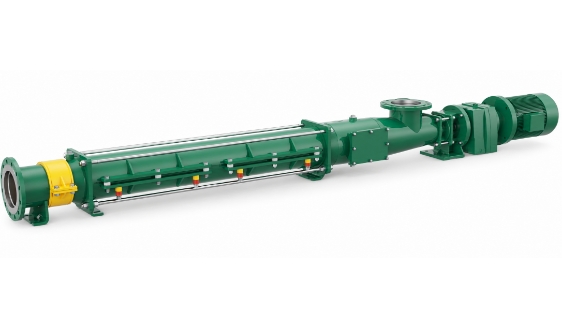
Industrial Wide Throat Pumps are specially engineered progressive cavity pumps developed to transfer challenging materials that are thick, dense, sticky, or contain a high concentration of solids. These pumps are particularly effective for products that do not flow easily under gravity and are difficult to handle with conventional pumping equipment.
What distinguishes a wide throat pump from a standard progressive cavity pump is its enlarged hopper-style inlet and integrated conveying screw. The wide inlet allows bulky and highly viscous media to enter the pump more efficiently, while the feed screw continuously moves the material toward the rotor-stator assembly. This combination ensures a steady, uninterrupted flow and reliable pumping performance, even when processing hard-to-handle substances such as sludge, pastes, biomass, food waste, and industrial slurries.
Designed for demanding industrial applications, wide throat pumps help minimize blockages, improve product transfer efficiency, and maintain smooth operation when handling materials that would typically be difficult to pump using standard pump designs.


Types of Wide Throat Pumps
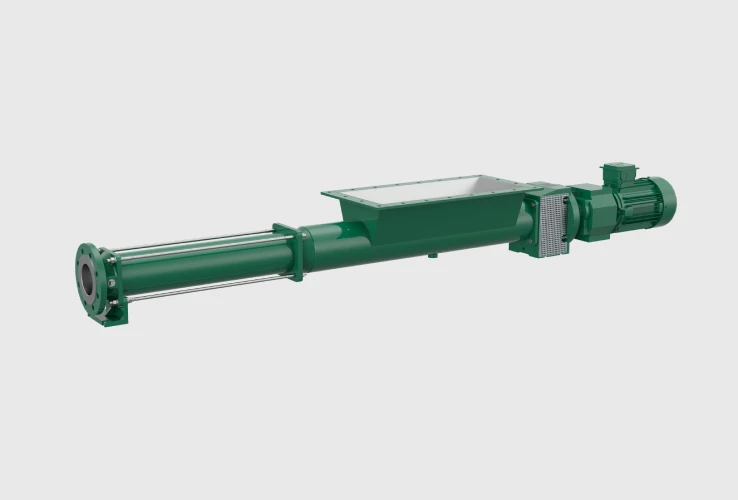
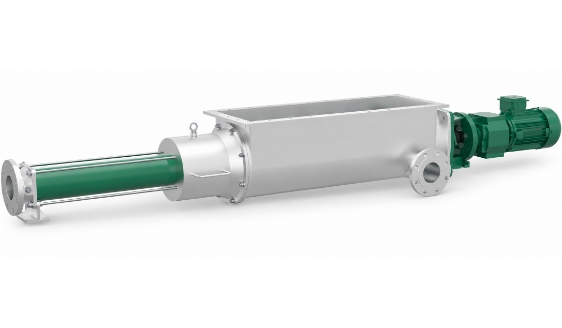
Standard Wide Throat Pump
- Flow Rate : Up to 220 m 3/hr / 970 GPM
- Pressure : Up to 24 Bar / 350 PSI
Standard Wide Throat Pumps are engineered with a large adaptable rectangular feed hopper with compression zone, and an auger feed screw. These pumps are designed for handling highly viscous and solid-laden media with low flowability, ensuring optimal efficiency in demanding conditions.
These progressive cavity pumps are designed specifically for applications requiring a large inlet area to handle highly viscous, non-flowing, and solids-laden media. Its defining feature is a wide rectangular hopper inlet, which allows bulky, sticky, or dewatered materials to enter the pump without bridging or blockage.
Small Wide Throat Pumps
- Flow Rate : Up to 280 m 3/hr / 1230 GPM
- Pressure : Up to 24 Bar / 350 PSI
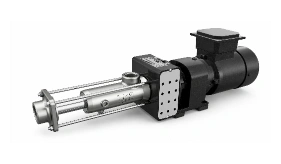
Small Wide Throat Pumps are designed with an enlarged suction opening and a short auger. They are compatible with standard suction casings, allowing for easy interchangeability. These pumps are ideal for handling medium viscous media, especially in applications requiring larger inlets due to challenging suction conditions.

Unique Design for Large Suction
In many industrial systems, materials such as dewatered sludge or thick paste do not flow under gravity, tend to bridge or compact at the inlet, and require mechanical assistance to enter the pump. Wide throat pumps are specifically engineered to overcome these challenges through a large open hopper, an integrated screw feeder with a compression zone, and a progressive cavity pumping element ensuring continuous, pressure-stable, and low-pulsation transfer of difficult media.
Why conventional suction fails in such applications
- Media does not flow naturally under gravity
- Bridging and compaction at the inlet are common
- Passive suction is ineffective for high solids content
How wide throat pumps solve this
- Large open hopper enables bulk material intake
- Screw feeder (auger) ensures forced and continuous feeding
- Compression zone improves material consistency before pumping
- Progressive cavity mechanism ensures smooth transfer
Engineering advantages achieved
- Increased inlet cross-sectional area improves suction conditions
- Forced feeding enhances pump filling efficiency
- Reduced cavitation risk during operation
- Improved stator life due to uniform loading
- Consistent volumetric efficiency and stable performance
Key Benefits of Design
Reliable Feeding of Non-Flowing Media
Handles sludge cake, paste, and semi-solids that cannot self-flow.
Pressure-Stable & Smooth Flow
Progressive cavity design ensures steady discharge regardless of system pressure.
Integrated Feeding Mechanism
Eliminates need for external conveyors or feeding systems.
Low Pulsation & Gentle Handling
Ideal for shear-sensitive and structured materials.
Multi-Function Capability
Some configurations combine:
- Feeding
- Pumping
- Size reduction
Reduced System Complexity
Combines multiple process steps into one unit, reducing footprint and cost
Technical Features

Enlarged Hopper Inlet
- Rectangular or square geometry
- Designed for bulk feeding
- Customizable size
Feed Screw & Force-Feed Chamber
- Ensures continuous material movement
- Prevents air entrapment
- Improves suction efficiency
Rotor-Stator System
- Positive displacement mechanism
- Handles solids and viscous fluids
Modular Construction
- Different rotor/stator geometries
- Material options for abrasive/corrosive media
Speed-Proportional Flow
- Enables precise dosing and control
Dry Running Protection Device:
To prevent the stator damage due to dry running, specially developed temperature sensor is screwed into the stator wall to monitor the operating temperature. If by any chance the pump runs dry, the stator temperature would increase. Roto DRP would switch off the pump at pre set temperature.

Pressure Switch:
To prevent the pump from damage due to over pressurization in the discharge as well as low pressures beyond the capability of the pump. This system trips the pump and protects the pump as well as the system.

Gauges (Pressure, Vacuum, and Differential):
These devices are especially important for the system with dynamic working characteristics, that require constant monitoring. The selection of gauge requires consideration of process, environment, accuracy, dial size, connection & mounting. It is advised to limit the normal working pressure to 25-75% of the scale of the gauge.

Relief Valves:
In addition to relieving excess pressure from closed-top vessels or piping systems, these normally closed valves provide system control benefits. It is versatile and widely utilized valve. Its compact size, ease of setting, readjustment and repeatability, all contribute to its popularity. The pressure setting is done manually.

Strainers:
A Strainer is an inexpensive “insurance” for protecting pumps. There is often unwanted matter present which can cause serious problems. Dust, foreign matter or even clumps of product itself, can clog or damage critical & expensive equipment. Another factor to consider is the cost of downtime.

Roto Progressive Cavity Pump Range